









鱼币是殷商中期的货币,是青铜材质的鱼形钱币,出土于1974年,是由居住在黄淮间的部族,即所谓东夷、淮夷、徐夷者所创作的。并且鱼币是世界上唯一的鱼形钱币!
The fish coin is the currency of the middle period of the Shang Dynasty. It is a fish-shaped coin made of bronze. It was unearthed in 1974 and was created by the tribes living in the Yellow River, the so-called Dongyi, Huaiyi and Xuyi. And fish coins are the only fish coins in the world!

海外拍卖行毛生微信13790012565
Overseas auction house Mao Sheng WeChat 1379 0012565
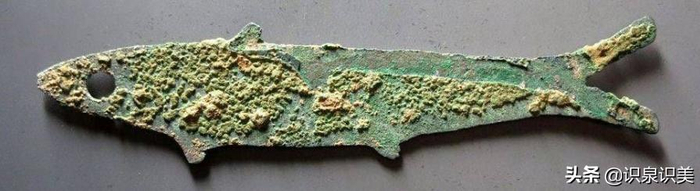
鱼币,流行于春秋战国,多见于墓葬,纹饰复杂多样。是否应该定义为货币,还存在一些争议。
ish coins, popular in the Spring and Autumn and Warring States period, are more common in tombs and have complex and diverse patterns. Whether it should be defined as a currency is still controversial.

鱼币可能是春秋战国时期,居住在黄淮间的部族,所谓东夷、淮夷、徐夷者所创作的。这些部族,滨水而居,以渔猎为主,经常食用鱼类,贮藏鱼类,免不掉以之互相交换,互相馈赠。后来有了交易行为,便以鱼为代表价值的砝码。既受到中国文明的影响,跃入货币经济,便用鱼为货币。
鱼币的金属成分主要是铜加上适量的铅、锡。它们长的有10多厘米,短的仅几厘米,宽1厘米左右,厚约0.2厘米。多数鱼币正面的鱼体各部位铸工精细,反面则平平无纹,也有双面工的。鱼币都以鱼头部位的圆孔为眼睛。事实上我国的鱼币分布十分广泛,在全国许多省份都有发现,大部分的鱼币以青铜作为材质,也有其他金属或玉石作为材质的。它们虽都为鱼形,但造型各异,即使鳞片也变化丰富。
Fish coins may have been created by the tribes living between Huang and Huai during the Spring and Autumn Period and the Warring States Period. These tribes, who live on the waterfront, mainly fish and hunt, often eat fish and store fish, so that they can not exchange with each other and give each other gifts. Later, when there was a trading behavior, fish was used as the weight of value. Affected by Chinese civilization, it jumped into the currency economy and used fish as currency.
The metal composition of fish coins is mainly copper plus appropriate amounts of lead and tin. They are more than 10 cm long, only a few centimeters short, about 1 cm wide and about 0.2 cm thick. Most fish coins have fine casters on the front of the fish body, while the opposite side has no lines, and there are also double-sided workers. Fish coins use round holes in the fish's head as their eyes. In fact, the distribution of fish coins in China is very extensive. It has been found in many provinces throughout the country. Most of the fish coins are made of bronze, and other metals or jade are used as materials. Although they are all fish-shaped, they are of different shapes, and even the scales are rich in change.

《古钱大辞典》载近代著名泉家郑家相《贝化概说》:“渔民所用之化币,于贝化之外,更有所谓鱼币者,鱼币亦铜质,鱼形,一面平夷,有首有尾,有目有鳞,如半爿之符鱼,大小不一,有二寸许者,有寸许者,近在黄河沿岸,颇有出土,制作简单,每有一孔,以便穿贯。或疑非币。予曰,此上古金属时期黄河沿岸所用之币也。渔民于贝化之外,而复铸此鱼形之币,与贝化并行,其值必较大于贝化。当金属时期,农业发达,渔民势力逐渐减少,故渔民所铸贝化及鱼币,行用时间甚短,而农民所用之铲布,渐次普遍,贝化、鱼币遂归淘汰”。但该著的编者丁福保先生认为鱼币非币。在其他泉著中也未见有鱼币的记述。
The "Ancient Money Dictionary" contains the famous modern Quanjia Zhengjiaxiang's "Beihua Overview": "The currency used by the fishermen, in addition to Beihua, is even more so-called fish coins, fish coins are also copper, fish-shaped, one side Pingyi, there is a tail, There are scales, such as half a rune fish, different in size, two inches of Xu, there is an inch of Xu, near the Yellow River coast, quite unearthed, simple to make, each with a hole in order to pass through. Or suspected non-currency. To Yu, the currency used along the Yellow River during this ancient metal period was also used. Fishermen in addition to shellfish, and recasting this fish-shaped coin, in parallel with shellfish, its value must be greater than shellfish. When the metal period was developed, the agricultural industry was developed and the fishermen's forces gradually decreased. Therefore, the time for the fishermen to cast shellfish and fish coins was very short, and the shovels used by farmers were gradually becoming common. The shellfish and fish coins were eliminated. " However, the editor of the book, Mr. Dingfubao, believes that fish coins are not coins. There are no accounts of fish coins in other Springs.
《中国钱币》1993年第二期刊载了王桂枝先生撰写的一篇文章《浅谈 国墓地出土的货币》。文称1974年至1981年,考古工作者在宝鸡市茹家庄、竹园沟等地发掘了一批西周的墓葬,共发现海贝706枚、石贝216枚、玉贝68枚、蛤蜊贝204枚、铜鱼币540枚、锡鱼币8枚、玉鱼币80枚。铜锡鱼币均有使用痕迹,有的磨损较为严重,说明流通时间较长。这些与贝币共存的鱼形币均属于货币,并引用了《泉币》鲍鼎先生等多名近代泉家对鱼币肯定的看法。
The second issue of "Chinese Coins" in 1993 published an article written by Mr. Wangguizhi, "On the Currency Unearthed in the National Cemetery." According to the article, from 1974 to 1981, archaeologists excavated a group of tombs of the Western Zhou Dynasty in Rujiazhuang and Zhuyuangou in Baoji City. A total of 706 seashells, 216 Shibei, 68 jade shells, and 204 clams were found. 204 pieces of copper fish coins, 540 tin fish coins, and 80 jade fish coins. Copper tin fish coins have traces of use, and some wear is more serious, indicating that the circulation time is longer. These fish-shaped coins that coexist with shellfish are all currencies, and they quote the views of many modern spring families such as Mr. Baoding and others on fish coins.
最后总结下古钱收藏 还要看它的品相,品相是指古钱本身的锈蚀程度及钱文轮廓的清晰程度,一枚古钱既稀有,同时又具备良好的品相那是最好不过了,钱文虽然特殊,如果面目不清,锈成一团,那收藏价值也会大打折扣。所以请各位藏友们把古钱币妥善保存好,未来也许可以成为一笔属于您的财富。
In the end, the ancient money collection also needs to look at its appearance. The appearance refers to the degree of rust of the ancient money itself and the clarity of the outline of the money. An ancient money is rare and has a good quality at the same time. It is the best. Although Qianwen is special, if his face is unclear, The value of the collection will be greatly reduced if it is rusted. So please keep the ancient coins in good condition, and the future may become a treasure for you.
目前藏品持有人欲将此珍品结缘于有缘之士,参加2019年迪拜春拍拍卖会,有兴趣可搜索登陆深圳永煊文化发展有限公司官网,预约贵宾名额,一览珍品风采!
At present, the holder of the collection wants to tie this treasure to a person who is destined to participate in the 2019 Dibaichun auction. He is interested in searching and landing on the official website of Shenzhen Yongyi Culture Development Co., Ltd., booking VIP places, and a glimpse of the treasures!